
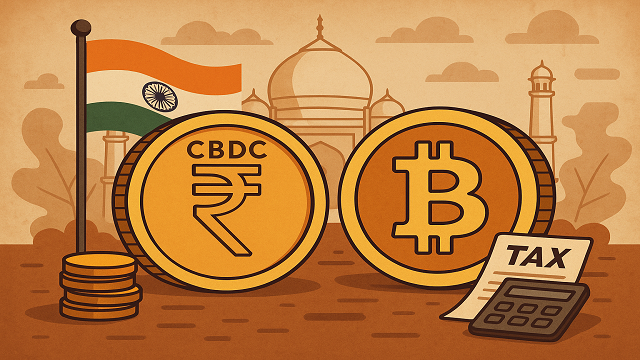
India has emerged as one of the most influential players in the global crypto conversation. With a population of over 1.4 billion people and a booming digital economy, the country’s decisions carry enormous weight for the future of blockchain and digital assets. In recent years, India has taken a cautious but deliberate approach to cryptocurrency regulation. While strict taxes and compliance rules have slowed down retail trading, the government has simultaneously advanced its own Central Bank Digital Currency (CBDC), popularly known as the Digital Rupee.
In 2025, the Reserve Bank of India (RBI) has accelerated its CBDC rollout, expanding pilot projects into wider public adoption. This development has sparked debate across the crypto community: will the Digital Rupee compete with or complement decentralized assets like Bitcoin? More importantly, how will India’s CBDC push affect Bitcoin adoption in the world’s largest democracy?
India’s Journey Toward a CBDC
The concept of a central bank digital currency is not unique to India. Countries around the world, including China with its digital yuan and Europe with its proposed digital euro, are exploring state-backed digital money. For India, the Digital Rupee represents both a modernization of the financial system and a response to the growing influence of cryptocurrencies.
The RBI began testing CBDC pilots in late 2022, starting with wholesale transactions between banks before expanding into retail trials in 2023 and 2024. By 2025, the project has scaled significantly, with millions of users experimenting with CBDC wallets across select cities.
The government highlights several benefits: faster payments, reduced cash dependency, greater financial inclusion, and improved efficiency in cross-border transactions. But behind these benefits lies a deeper agenda—strengthening regulatory control and reducing reliance on private cryptocurrencies.
CBDC vs. Bitcoin: A Fundamental Clash
While both CBDCs and Bitcoin fall under the umbrella of digital currency, they are built on very different principles. A CBDC like the Digital Rupee is centralized, government-issued, and fully regulated. Bitcoin, on the other hand, is decentralized, borderless, and resistant to censorship.
The introduction of the Digital Rupee could create a mixed impact on Bitcoin adoption. On one hand, greater awareness of digital payments might encourage Indians to explore Bitcoin as an alternative asset. On the other hand, stricter controls and surveillance tied to CBDC use might discourage citizens from engaging with decentralized cryptocurrencies.
The RBI has been vocal about its concerns with Bitcoin and other private cryptocurrencies, citing risks such as money laundering, terrorism financing, and volatility. With a CBDC in place, regulators may feel more empowered to restrict crypto trading further.
Impact on Retail Adoption
India’s retail investors have shown strong interest in Bitcoin over the past decade, despite regulatory uncertainty. Exchanges like WazirX and CoinDCX grew rapidly before heavy taxation slowed down volumes. The 30% flat tax on crypto gains and the 1% TDS on transactions imposed in 2022 remain in effect in 2025, discouraging small traders.
With the Digital Rupee gaining traction, the government may position it as a safer alternative for the general population. Incentives such as zero transaction fees, government-backed guarantees, and integration with banking apps could pull users away from Bitcoin. However, Bitcoin’s appeal as a store of value, especially in times of inflation or currency devaluation, remains strong. Savvy investors may continue to accumulate Bitcoin as a hedge, even if mainstream adoption slows.
Institutional Outlook
For institutions, the arrival of the Digital Rupee could streamline settlement processes and reduce costs in cross-border transactions. However, this also gives the RBI greater oversight into capital flows. For Bitcoin, this might mean stricter institutional barriers in India, as regulators prioritize CBDC-driven solutions over decentralized alternatives.
At the same time, global institutional adoption of Bitcoin is rising thanks to ETF approvals in the US and Europe. If Indian regulators choose to align with these global developments, there could still be room for Bitcoin to coexist alongside the Digital Rupee.
Opportunities for Coexistence
It is possible that India’s CBDC and Bitcoin adoption will not be mutually exclusive but rather complementary. For everyday transactions, the Digital Rupee may dominate due to its stability and legal backing. For wealth preservation and international transfers, Bitcoin may continue to serve as a valuable alternative.
Startups in India may also find opportunities to build hybrid solutions, integrating CBDC payments with Bitcoin and other cryptocurrencies. For example, platforms could allow users to move seamlessly between Digital Rupees and Bitcoin, depending on their needs.
Global Context
India’s approach mirrors a global trend. Central banks are eager to launch digital currencies to retain control over monetary policy in an increasingly digital world. Yet, Bitcoin continues to thrive globally as an asset class, with institutional adoption growing year by year. The tension between CBDCs and Bitcoin is therefore not unique to India but part of a larger global story.
Conclusion
India’s CBDC push represents a bold step into the future of digital money. While it promises efficiency, security, and inclusion, it also raises questions about surveillance and financial freedom. For Bitcoin, the impact is complex. On one hand, stricter regulations and incentives for CBDC use may reduce mainstream adoption. On the other, growing awareness of digital assets may encourage more Indians to see Bitcoin as a hedge against centralization.
Ultimately, the future of Bitcoin in India will depend on the balance between innovation and control. The Digital Rupee is here to stay, but so is the demand for decentralized alternatives. The coming years will reveal whether India can strike a balance that allows both to thrive.
Frequently Asked Questions About How India’s CBDC Push Will Impact Bitcoin Adoption
Q1. What is India’s CBDC?
Answer: India’s Central Bank Digital Currency, also known as the Digital Rupee, is a government-issued digital currency managed by the Reserve Bank of India.
Q2. Will the Digital Rupee replace Bitcoin in India?
Answer: Not directly. The Digital Rupee is designed for payments and everyday transactions, while Bitcoin serves as a decentralized store of value. However, regulations may affect how widely Bitcoin can be used.
Q3. How does India tax Bitcoin in 2025?
Answer: Bitcoin remains subject to a 30% flat tax on gains and a 1% TDS on transactions, making it one of the most heavily taxed crypto environments in the world.
Q4. Can CBDCs and Bitcoin coexist?
Answer: Yes, CBDCs may dominate payments, while Bitcoin could remain popular as a long-term investment and inflation hedge.
Q5. How does India’s CBDC compare to other countries?
Answer: Similar to China’s digital yuan, India’s CBDC is centralized and tightly regulated. In contrast, regions like the EU are still exploring balanced frameworks that may allow greater coexistence with cryptocurrencies.