
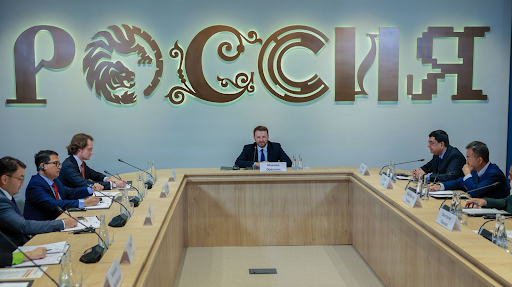
In Vladivostok, an Open Dialogue session at the National Centre “Russia” explored new financial and investment solutions for the World Majority nations. The discussion was moderated by Maxim Oreshkin, Deputy Head of the Administration of the President of the Russian Federation.
During the third discussion block, titled “New Financial and Investment Mechanisms for the World Majority”, participants stressed that in today’s shifting global economy, long-term sustainability requires digital integration and the development of interoperable payment systems.
Rupa Chanda, Director of the Trade, Investment, and Innovation Division at UN ESCAP, highlighted that the digitization of financial settlements must not be separated from trade, investment, and logistics.
“Financial tools must be embedded into a larger ecosystem — trade, investment, logistics. Initiatives for digitized trade and smart logistics already exist and should be integrated into a single framework,” she said.
This, she explained, would allow Global South countries not only to improve settlement efficiency but also to strengthen their positions in international trade.
She further emphasized that digitalization and technologies like blockchain could play a vital role in building interoperable systems and alternative financial mechanisms. At the same time, digitization must be connected to broader processes.
“Most cross-border payments are linked directly to trade and investment flows. If financial settlement mechanisms are embedded within the digital agenda, the impact will be much stronger,” Chanda noted.
Speaking at the session, Dr. Teguh Yudo Wicaksono pointed out that the Asia-Pacific region faces major challenges. He reminded that the region’s economy is heavily trade-dependent and has endured tough lessons in surviving crises.
“We have faced the difficulties of relying on a single currency as the dominant means of payment,” he said. “The consequences have been severe, which is why new strategies are being explored — already under discussion in Arab nations as well.”
Representing Indonesia, Dr. Wicaksono explained that his country is finalizing agreements with key trade partners — Malaysia, Vietnam, and China — to transition settlements into local currencies instead of the U.S. dollar.
“We are reducing dollar dependency. It would be beneficial if digital payment methods became more widely adopted in Russia too,” he added.
He mentioned that about 38 small producers are now working together, bypassing unfavorable global conditions to build independent systems that strengthen economic resilience.
Regional cooperation, according to him, is vital for Oceania and Asia-Pacific economies, ensuring smooth cross-border transactions. Estimates show that by the end of this year, the region could earn more than $3 billion in additional revenue — about 25% growth.
“The cross-border payment challenges demonstrate that Asia can be a model for practical solutions to counter Western pressure,” Wicaksono emphasized.
In conclusion, he said that economic independence is crucial but should complement the global system.
“Only in this way can efficiency, liquidity, and stability be achieved,” he concluded.